Sighthound Objects
Sep. 12th, 2011 05:27 pm![[personal profile]](https://www.dreamwidth.org/img/silk/identity/user.png) bunn
bunnI think sighthounds make very attractive shapes that remind me of Anglo Saxon objects.
For example, isn't this lovely and perfectly greyhound-like?
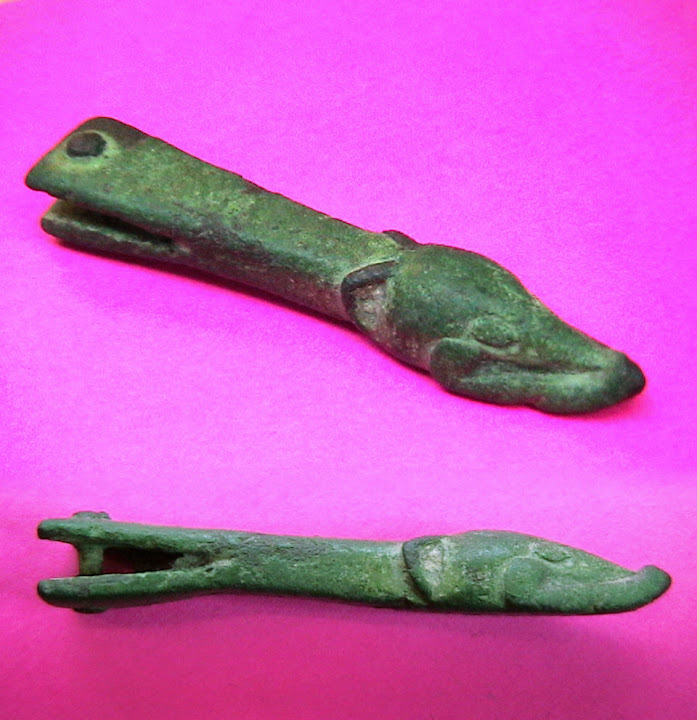
A late Anglo-Saxo
http://www.ukdfd.co.uk/ukdfddata/showrecords.php?product=4004&cat=109
This amazing ninth-century ring bezel - surely that is a sighthound? Though one with a plumy tail and feathers so maybe a little more like a saluki.

http://www.fabiandemontjoye.com/rings/middle-age/705-early-medieval-ring-gold-niello-saxon-art-century.html
This awesome silver ring shows a more short-muzzled animal - maybe more like a boxer? But it still has that amazing curve to the chest and those fabulous legs.
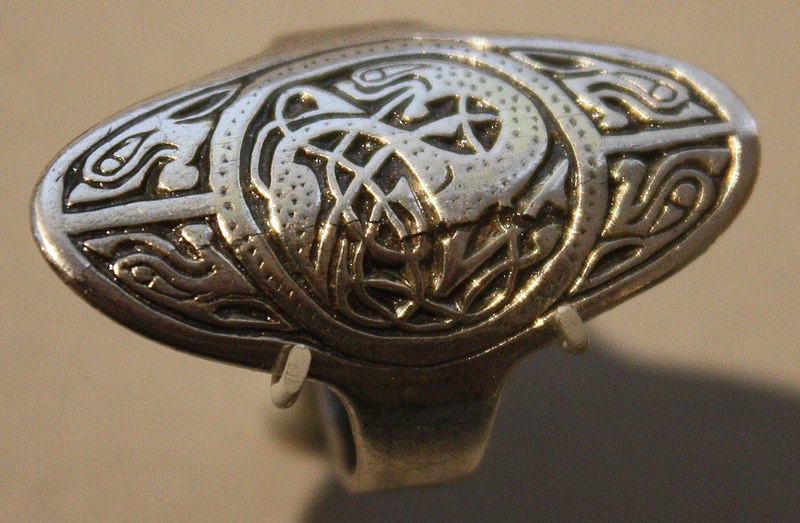
Silver ring 775-850, found in the river Thames at Chelsea
http://en.wikipedia.org/wiki/File:BLW_Silver_Anglo-Saxon_ring.jpg
Here are lots and lots of dogs on this brooch:

The Strickland Brooch, mid-9th century.
These are more doggy dogs - they could almost be exaggerated spaniels with their short bodies, round noses and feathered paws and tails.
The British Museum thinks that 'The Anglo-Saxons did not have pets like we do today, but dogs were used for hunting and protecting the home.' This strikes me as an extremely dubious statement. How can they possibly know that? *Frowny face*
http://www.britishmuseum.org/explore/young_explorers/discover/museum_explorer/anglo-saxon_england/birds_and_beasts/the_strickland_brooch.aspx
Does anyone know when this sort of elaborately knotted animal image got the label 'Celtic' stuck on it? And why?
(I agonised over how to do these links - should I make copies of the images, thus breaking the owner's copyright but preserving their bandwidth, or hotlink so they have control over where they are displayed?) In the end I hotlinked on the grounds that not many people are likely to be looking at this page - but if you own one of these images and would like this changed, just let me know).


![[identity profile]](https://www.dreamwidth.org/img/silk/identity/openid.png)

no subject
Date: 2011-09-13 08:19 am (UTC)I am wondering if by 'pets' they are using quite a narrow definition of the word. Even then, I can't see how you could prove it. These are people who had cows inside their houses after all, it seems a leap to say that an entire society over several hundred years never kept the old dog by the fire after his hunting days were over or hung onto the runt pup because he was no good at ratting but had floppy ears and the children loved him. And it's not as though 'working dog' and 'pet' are mutually exclusive... I shall look out for more information about this!
no subject
Date: 2011-09-14 05:24 am (UTC)But I suppose the Anglo-Saxons were a very different culture. Time for me to do some reading up!
no subject
Date: 2011-09-14 08:25 am (UTC)But I think archaeology isn't really very helpful when it comes to understanding how people *felt* which I think is the main question here. For that you need documents, which so far as I am aware, are pretty thin on the ground, particularly in the earlier Saxon period.